
Case Study
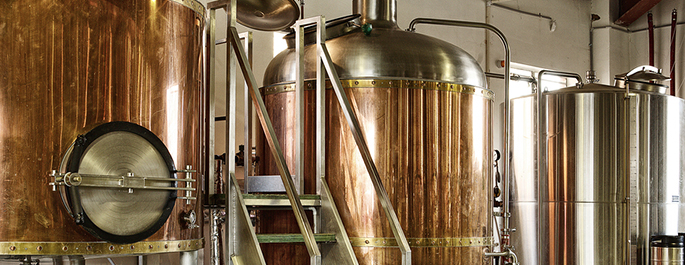
Anheuser Busch
Due to 100% outside and exhaust air requirements, a “total energy” heat wheel concept was used to minimize operational costs. The rotary wheel rotates through the parallel (but opposite flow) supply air and exhaust airstreams. This design, in conjunction with a molecular sieve desiccant impregnated within the rotating wheel, allows for both sensible and latent energy recovery. The efficiency of the wheel is near 90%, thus saving thousands of operating dollars each and every month of the year.
The unit was located in the basement area of the building. Housekeeping and hygiene issues related to condensation forming on the unit exterior were important. Air Enterprises provided double wall all-aluminum panels with a thermal break to alleviate this concern. The structural support base was also designed with thermal breaks to limit condensation.
Unit components consisted of supply air and exhaust air fans (DWDI or plenum type), premium efficiency TEFC motors, copper fin/copper tube chilled water coils with double pitched stainless steel condensate drain pans, 30% filters, and the energy recovery wheel. Lights, air flow measuring devices, and control sensors were also provided by Air Enterprises. The unit configuration was a stacked over/ under design with the exhaust air system built on top of the supply air system. Field start-up services and operational factory testing were also provided.
International Flavors & Fragrances

Air Enterprises’ ability to design, secure approval, fabricate, and ship custom air handling units within two months of date of order was key to the overall success of the project. The client needed to minimize disruptions to the operations conducted in the affected spaces.
Unit vibration was a major concern at this location. Air Enterprises furnished centrifugal fans balanced (in all planes) as an installed assembly to provide the best attainable vibration characteristics.
The existing facility posed significant limits on the size of equipment that could be moved into place. Each air handling unit had to pass through a doorway 4’10” wide and 6’9” high on a 6’0” wide corridor. AC-3 and AC-5 were built in sections except for the fan sections. The fan sections and all of AC-6 were shipped knocked down for erection in place.
All units feature Air Enterprises’ all-aluminum pan and panel construction. Pans feature 1/8-inch thick aluminum treadplate floors. All units include filtration to 85% efficiency, integral face and bypass type steam preheat coils, chilled water cooling coils with sloped drain pans to assure positive drainage of condensate, and airfoil type centrifugal supply air fans.